
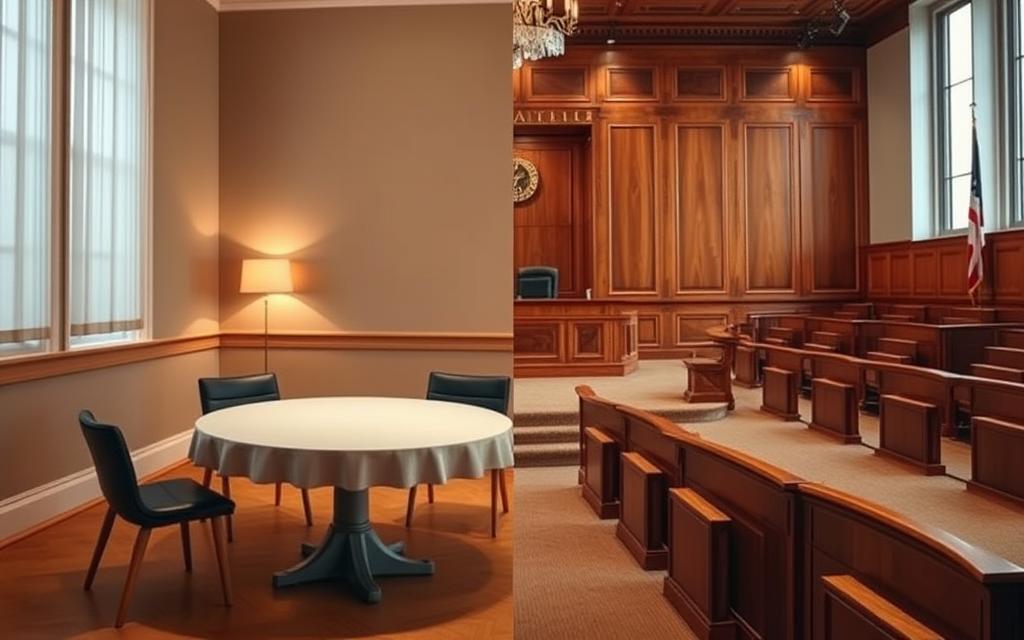
Learn the key differences between divorce mediation vs court proceedings, including costs, timeline, and control over decisions. Make an informed choice for your divorce case.
Divorce Mediation vs Court:
Going through a divorce can feel scary and sad. It makes people unsure about how to handle it. You might be thinking about mediation or going to court. But which one is best for you? This article will help you decide.
Choosing between mediation and court can really change your divorce. It affects your money and feelings. Have you thought, What are the big differences between these two ways, and how will they affect your divorce?
Key Takeaways
- Mediation is usually faster and cheaper than going to court.
- Litigation can make things more tense, while mediation helps you talk things out.
- If there’s a lot of conflict, violence, or hidden money, you might need court.
- Mediation lets you make your own solutions, but court follows strict rules.
- Mediation is 30-40% cheaper than a lawyer, and court cases can cost a lot more.
Understanding Divorce Mediation
Divorce mediation is a way to solve issues without going to court. It brings both sides together with a neutral person. This person helps them talk and find an agreement they both can live with.
What is Divorce Mediation?
Divorce mediation is when both sides work together to agree on their separation. They talk about child custody, child support, alimony, and property division with a mediator’s help. The mediator helps them talk and find common ground.
Key Benefits of Divorce Mediation
- Cost-effectiveness: It’s cheaper than going to court, saving on legal fees and court costs.
- Time-saving: It’s faster than court, helping couples move on with their lives.
- Promoting open dialogue: It makes spouses talk openly, leading to better amicable divorce settlements.
- Confidentiality: Talks are private, keeping things safe and confidential.
- Flexibility: Couples can make their own agreement, fitting their needs and wants.
Common Misconceptions about Mediation
Some think mediation is only for couples with no conflict. But, it works even in tough situations if both sides are willing to communicate, compromise, and be transparent. It’s not good for cases of domestic violence or substance abuse, as it’s not fair.
The Court Process in Divorce
Divorce litigation is when one person files for divorce and is called the plaintiff. The other person is called the defendant. This process follows steps set by state laws and court rules.
Steps in the Court Process
- Filing the divorce petition
- Serving the divorce papers to the defendant
- Responding to the petition
- Exchanging financial and other relevant information
- Negotiating child custody, support, and asset division
- Attending court hearings and trials
- Finalizing the divorce decree
Advantages of Going to Court
The court process helps solve complex financial and legal issues. It requires both sides to share financial details. This is good for contested divorce litigation cases with big assets or child custody issues.
Disadvantages of Court Battles
But, going to court can be very expensive. It also makes things take longer, which can make feelings worse. Plus, court cases are public, unlike mediation which is private.
| Advantages | Disadvantages |
|---|---|
| Address complex financial and legal issues | Higher costs |
| Mandatory financial disclosure | Time-consuming process |
| Subpoena power | Potential to exacerbate emotional tensions |
| Public proceedings |

Comparing Costs: Mediation vs. Court
When you’re getting a divorce, money matters a lot. Choosing between mediation and court can really affect your costs. Let’s look at the costs of each to help you decide.
Cost Breakdown of Mediation
Mediation is often cheaper than going to court. It settles over 85% of disputes, usually in 30 days. Costs can be just a few thousand dollars, much less than court battles.
How Court Costs Add Up
Going to court is very expensive. Costs can be $50,000 to $150,000 or more. In some cases, legal fees hit the millions.
Hidden Fees in Both Processes
Both mediation and court have hidden costs. Mediation might include document prep fees. Court costs include extra fees for appearances and procedures.
Mediation is a good choice for those looking to save money. Knowing the costs helps you choose wisely for your situation.
Emotional Impact: Mediation vs. Court
Going through a divorce can be very hard on your feelings. The way you handle it, like mediation or court, really matters. It can help you feel better and stay well.
Stress Levels in Mediation
Mediation is often easier on your feelings than going to court. It’s about working together to solve problems. This makes it less stressful for both sides.
It helps couples stay friendly, which is great for kids. They can talk openly and find solutions together. This leads to a divorce that’s easier on everyone.
Emotional Toll of Court Proceedings
Court battles can be very hard on your feelings. They are confrontational and public. This can make things worse between the couple.
It can also hurt their relationship after the divorce, like when they have to co-parent. The stress of court can really affect your mind and body.
Choosing mediation or court can greatly affect how you feel during and after your divorce. Mediation is more friendly and can make the divorce process easier. It helps everyone feel better in the end.
Time Considerations for Each Option
Time is very important in divorce. Mediation and court-based divorce have different times. Each has its own good and bad points.
Average Timeline for Mediation
Mediation usually makes divorce faster than going to court. You can pick when to meet, making it easier to fit into your schedule. This helps couples solve their issues quickly, often in just a few meetings.
The time it takes for a mediated divorce is usually 2 to 4 months. This depends on how complex the case is and how willing the parties are to work together.
Court Delays and Timelines
Going to court takes longer and can have delays. It involves many legal steps like hearings and discovery. These steps can make the divorce last longer, sometimes for years.
The court’s busy schedule and waiting periods also add to the time. So, choosing between mediation and court depends on how fast you want the divorce to be.
Flexibility and Control in Mediation
Going through a divorce can be tough.  But, mediation can help. It lets couples make their own agreements.
Mediation is different from court. In court, a judge decides. But in mediation, couples work together. They make decisions that fit their needs.
Making Decisions Together
In mediation, couples can talk and agree on things. They can find solutions that work for their family. This way, they feel more in control.
Customizing Agreements in Mediation
Mediation lets couples make agreements that fit them. They can talk about things like money and kids. This is different from court, where rules are strict.
Choosing mediation means couples can make their own way. They can create agreements that feel right for them. This can make the divorce process easier and less stressful.
Legal Outcomes: Mediation vs. Court
Legal outcomes differ a lot between divorce mediation and court fights. Mediation agreements are legally binding once the court approves them. But, either side can leave without an agreement during mediation.
Court judgments, on the other hand, are binding right away. If someone doesn’t follow the court’s orders, the other can take legal action to enforce it.
Enforceability of Mediation Agreements
Mediation agreements are usually enforceable. They show a mutual understanding between both sides. The success rate of mediation in divorce is 80-85%.
When mediation works, 95% of the agreements get court approval.
Court Judgments: Binding Nature
Court judgments are legally binding. Both sides must follow the court’s orders. If someone doesn’t, the other can take legal steps to enforce it.
Mediation and court fights both aim to solve all marriage issues. The choice depends on the divorce’s specifics and how well the parties can work together.
The Role of Professionals in Each Process
Going through a divorce can be tough. Getting help from experts can really help. You might pick divorce mediation or go to court. Knowing what mediators and lawyers do is key.
Mediators vs. Lawyers
Mediators help couples talk and find common ground. They don’t take sides or give legal advice. They focus on making sure everyone talks and finds solutions together.
Lawyers, on the other hand, fight for what their clients want. They give advice and stand up for their clients in court.
How Each Professional Supports You
Divorce mediation lawyers help with big divorce issues. They make sure everything is covered, like money, kids, and support. They help couples talk and find fair deals.
Divorce court attorneys help in court. They fight for what their clients need. They guide through the court steps and help get the best results.
It’s smart to talk to a family law lawyer, even if you’re mediating. They help you know your rights and what agreements mean legally.
| Mediators | Divorce Attorneys |
|---|---|
| Neutral third-party facilitators | Client advocates in court |
| Focus on communication and collaboration | Provide complete legal representation |
| Guide discussions to reach mutually agreeable settlements | Advise on legal strategies and secure favorable outcomes |
| Do not provide legal advice | Offer legal counsel and expertise |
Choosing the Right Option for You
Deciding between mediation and litigation is very important. It affects your divorce process, money, and future relationships. Think about how much you and your spouse disagree, if you can talk and work together, your money situation, and if there’s violence at home.
Factors to Consider
If you and your spouse can talk and work together, divorce mediation might be best. It’s cheaper and faster, letting you control your life’s decisions. Mediation also helps you work together better, which is good for raising kids after divorce.
But, if there’s been abuse or your spouse won’t cooperate, you might need to go to court. Court is more expensive and takes longer. But, it gives you the legal help you need in tough situations.
Making an Informed Decision
Talking to a family law attorney is a good idea. They can give you advice based on your situation. They’ll help you see the good and bad of each choice, understand the law, and plan for your future. Remember, your choice will affect you for a long time, so think carefully and choose wisely.
FAQs
What is Divorce Mediation, and How Does it Differ from Traditional Court Proceedings?
Divorce mediation is like a friendly talk. Traditional divorce feels like a court fight.
In mediation, you and your spouse work with a neutral person. You settle things like who gets what or who gets the kids. It’s a way to solve problems without going to court. Court proceedings, on the other hand, have a judge making decisions for you.
Mediation:
- Informal, private, and flexible.
- Focused on finding common ground.
Court:
- Public, formal, and time-consuming.
- Decisions made by a judge.
If you want control and privacy, mediation is a good choice!
What Are the Advantages of Choosing Divorce Mediation Over Court?
Why fight when you can agree? Divorce mediation has many benefits:
- Reduced stress: No courtroom drama.
- Cost-effective: Mediation is often cheaper than hiring lawyers for court.
- Faster resolution: Mediation typically wraps up quicker.
- Amicable settlement: You work together, which is great for co-parenting.
Mediation is like solving a puzzle together instead of fighting over the pieces.
Can I Represent Myself in Divorce Mediation?
Yes, you can try self-representation in mediation. But is it a good idea? It depends.
- Pros: Save money on attorney fees.
- Cons: Lack of legal expertise might leave you vulnerable.
Consider consulting a lawyer for advice before starting the mediation process. Even a little help can go a long way!
Is Divorce Mediation Suitable for All Couples?
Not every couple is a fit for mediation. It works best for those willing to compromise.
- Good fit: Low-conflict situations or couples who want an amicable split.
- Not ideal: High-conflict situations, cases with abuse, or highly complex legal issues.
If trust and communication are totally broken, court might be the only option.
What Happens if We Can’t Reach an Agreement During Mediation?
If mediation fails, it’s not the end. You’ll likely head to court proceedings next.
Options after failure:
- Continue mediation with a new mediator.
- Proceed with legal action.
Mediation is just one tool in the alternative dispute resolution toolbox. If it doesn’t work, you have other options!
Why Is Mediation Better Than Court?
Mediation is like a friendly handshake. Court feels like a boxing match. So, why is it better?
- Cost-effective: Mediation is usually way cheaper than dragging a case through court.
- Faster resolution: You could wrap it up in weeks, not months or years.
- Private and confidential: Court is public; mediation keeps your business out of everyone’s ears.
- Control over decisions: You decide the terms, not a judge who barely knows you.
Mediation is all about collaboration. It’s ideal for couples who want to split amicably.
What Are the Disadvantages of Divorce Mediation?
Mediation isn’t perfect, though.
- Not legally binding: You’ll need to finalize the agreement in court.
- Power imbalances: If one spouse is more dominant, it might feel unfair.
- No legal advice during sessions: Mediators can’t give legal guidance like attorneys.
Mediation is a great option, but it’s not the answer for every situation.
What Is a Serious Drawback to a Court of Mediation?
One big drawback is that mediators don’t have the power to enforce agreements. If things fall apart, you’re back to court.
It can also feel frustrating if the other party isn’t honest or cooperative. Mediation works best with mutual trust.
How Often Is Mediation Successful?
Surprisingly, mediation works most of the time—about 70-80% of cases settle successfully!
The key is both parties coming in with an open mind.
What Are Three Disadvantages to Mediation?
- Not binding: You’ll need a legal process for enforcement.
- No guarantees: It only works if both parties cooperate.
- Power dynamics: A dominant spouse can influence decisions unfairly.
What Percentage of Mediation Settlement?
Around 85% of mediation cases reach a settlement!
Mediation helps couples save time, money, and stress while finding common ground.