

Learn how property division in divorce works, from equitable distribution to community property laws. Get expert insights on splitting assets and protecting your rights.
Property Division in Divorce:
Divorce is complex and emotional. One key part is dividing property. But what is “property” in a divorce? How is it split? Are there state differences in property division?
As you deal with property division, a big question is: How can you make sure assets are divided fairly during your divorce?
Key Takeaways
- Marital property includes all income, assets, and debts from the marriage, no matter who owns them.
- Separate property, like gifts or inheritances, can become marital if mixed with other money or increased in value.
- State laws control property division, with some following community property rules and others using equitable distribution.
- When dividing property, the length of the marriage, each spouse’s money situation, and their contributions are considered.
- Mediation or collaborative divorce can help avoid court and make the process friendlier.
Understanding Property Division in Divorce
Property division is key in divorce. It splits up what couples own and owe. This makes sure both get a fair share, helping them financially after the split.
What is Property Division?
It covers everything bought or owed during marriage. This includes homes, cars, retirement funds, and debts. The aim is to split these fairly between the two.
The Importance of Fair Distribution
Getting property split right is very important. It affects both spouses’ money situation. In community property states, things are split more evenly. But in equitable distribution states, it’s about fairness, not always equal.
Dividing things fairly is key to get a judge’s okay. Most divorces are settled without going to court. This way, couples can avoid the stress of a judge deciding on their stuff.
| Property Division Approach | Description |
|---|---|
| Community Property States | Most property acquired during the marriage is jointly held, leading to a more equal division. |
| Equitable Distribution States | Marital property is divided fairly, but not necessarily equally, based on various factors. |
In places like Kansas, property is divided fairly by a judge. But it’s not always 50/50. This is different from community property states like California and Texas, where things are split more evenly.
Types of Property in Divorce
Understanding the different types of property in divorce is key. The law divides property into marital property and separate property. This helps in dividing assets and debts fairly.
Marital vs. Separate Property
Marital property includes things like the family home and cars. It also includes retirement accounts and investments shared by both spouses. These are divided fairly between the two.
Separate property is what one spouse owned before the marriage. It can also be gifts or inheritances. This property usually stays with the original owner.
The Role of Assets and Debts
Assets and debts are important in dividing property. Marital debts, like mortgages, are shared. Separate debts are not.
Knowing if something is marital or separate is key. It helps in dividing things fairly. This affects the financial future of both spouses.

The Process of Property Division
The divorce process is complex, and dividing property is often the hardest part. It involves several steps. First, you identify and list all assets and debts. Then, you figure out their value. After that, you try to agree on how to split them.
Couples need to make detailed lists of all shared property. This includes homes, investments, personal items, and debts.
Steps Involved in Property Division
- Information gathering: Spouses must share all financial details, like assets, debts, income, and expenses.
- Valuation of assets: You need to find out what each asset is worth. This includes homes, retirement accounts, or businesses.
- Negotiation or mediation: Couples try to agree on how to split their assets. They might use lawyers to help.
- Litigation: If they can’t agree, a judge will decide how to split the property.
- Finalization: The judge’s decision is written into the divorce decree. This makes the agreement official.
Timeline for Property Division
The time it takes to divide property varies. It depends on how complex the assets are and how well spouses work together. Negotiation or mediation can take months. But, if it goes to court, it can take a year or more.
It’s important to think about the long-term effects of dividing property. These decisions can greatly affect your financial future.
| Divorce Aspect | Average Timeline |
|---|---|
| Identification of Assets | 1-3 months |
| Asset Valuation | 2-6 months |
| Negotiation/Mediation | 3-6 months |
| Litigation | 12-24 months |
| Finalization | 1-3 months |
Knowing the steps and timeline helps couples prepare for dividing property. It makes it easier to find a fair solution.
Factors Influencing Property Division
Courts look at many things when dividing property in a divorce. They consider the length of the marriage and what each spouse brought to the table. This includes money and other kinds of help.
Duration of the Marriage
The length of the marriage is very important. Longer marriages mean more shared money and things. Courts think both spouses have worked hard, with money and by taking care of the home and kids.
Each Spouse’s Contributions
Courts also look at what each spouse did, with money and without. Money can be income, savings, and investments. Non-money things are like taking care of the house and helping with school and work.
| Factors Influencing Property Division | Explanation |
|---|---|
| Alimony considerations | Courts might think about alimony when dividing things. Alimony helps the spouse who made less money to keep up with the other. |
| Financial contributions | Each spouse’s money, savings, and investments are looked at when dividing things and debts. |
| Non-financial contributions | Work like taking care of the house, raising kids, and helping with school and work is seen as very important. |

Courts try to divide things fairly. They look at what each spouse did during the marriage. This way, they make sure everyone gets what they deserve.
Legal Framework for Property Division
The rules for dividing property in divorce vary across the U.S. Some states use a community property system. Others follow an equitable distribution approach. Knowing your state’s laws is key when dividing assets in a divorce.
Community Property States
Nine states in the U.S. – Arizona, California, Idaho, Louisiana, Nevada, New Mexico, Texas, Washington, and Wisconsin – are community property states. Here, assets and debts from the marriage are split 50/50. This is based on joint ownership and both spouses’ contributions.
Equitable Distribution States
Most U.S. states, including 41 states and Washington D.C., use equitable distribution. Courts try to divide assets fairly, looking at each spouse’s financial situation and contributions. The division might not always be 50/50.
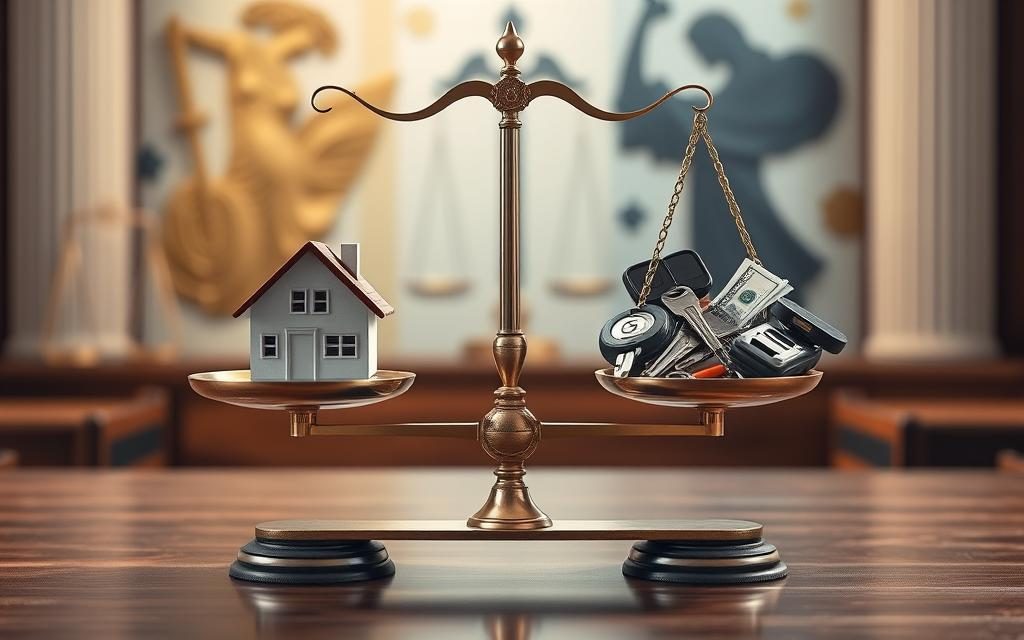
Even in equitable distribution states, rules can vary. For example, Alaska, Florida, Kentucky, South Dakota, and Tennessee let couples choose community property if they want.
Dividing property in a divorce can be hard and often leads to disagreements. Getting help from a skilled divorce lawyer is important. They can protect your rights and make sure assets are divided fairly under your state’s laws.
Negotiating Property Division
Divorce can be tough, but talking about property division can help. Couples can find better solutions by negotiating outside court. They can use divorce mediation or collaborative divorce.
Mediation as an Option
Mediation uses a neutral third-party to help couples agree on property division. It’s less stressful and can save money. Both sides must talk openly and be willing to compromise.
Collaborative Divorce Approaches
Collaborative divorce means working together to solve problems. Both spouses and their lawyers aim for a peaceful solution. This way, they can find solutions that fit their unique situation.
Choosing divorce mediation or collaborative divorce can lead to better outcomes. It can make the process less stressful, cheaper, and give more control over the outcome.
| Method | Key Characteristics | Potential Advantages |
|---|---|---|
| Divorce Mediation | Neutral third-party mediator guides the process | Less adversarial, more cost-effective, allows for creative solutions |
| Collaborative Divorce | Spouses and attorneys work cooperatively to resolve issues | Encourages cooperation, tailored to couple’s unique needs |
Handling Hidden Assets
Divorce often means dividing up what couples own together. But, hidden assets can change this. Spouses might hide money by not reporting all income or by paying too much in taxes. Financial disclosure is key in divorce, and both must tell the truth.
Identifying Concealed Property
Finding hidden assets is hard, but there are ways. Asset discovery can involve looking at financial records or searching public records. Experts, like forensic accountants, can also help find hidden money.
Legal Consequences of Hiding Assets
Hiding money in a divorce can lead to big problems. Courts don’t like it and might fine the person or take away more of their stuff. If hidden assets are found, the court might make the person who hid it give some of that money to their ex.
Being open and honest is important for a fair divorce. Knowing how to hide assets and the legal risks helps protect everyone’s rights. This way, property can be divided fairly.
| Tactic | Description | Potential Consequences |
|---|---|---|
| Underreporting Income | Reporting lower income or claiming excessive deductions to reduce taxable income | Financial penalties, unfavorable property division, possible jail time |
| Creating Fake Debts | Fabricating or inflating debts to offset the value of assets | Financial penalties, unfavorable property division |
| Offshore Accounts | Using foreign bank accounts or entities to hide funds | Financial penalties, unfavorable property division |
| Large Cash Transactions | Engaging in cash-based transactions to avoid creating a paper trail | Suspicion of asset concealment, possible discovery efforts |
The Role of Attorneys in Property Division
Going through a divorce can be tough. It’s full of complex steps, like dividing property. Divorce attorneys are experts in family law. They offer legal representation to help with property division.
Benefits of Hiring a Divorce Attorney
Divorce attorneys make sure assets are divided fairly. They know how to find and value what’s yours. They also deal with tricky legal stuff and protect your rights.
They use their property division expertise to guide you. They talk for you and make sure your rights are looked after.
How to Choose the Right Attorney
- Find an attorney with lots of experience in property division.
- Make sure they know the local divorce laws well.
- Choose someone who talks to you in a way you understand.
- Ask if they have a good track record in property division.
- See if they answer your calls and keep you updated.
Finding the right divorce lawyers is key. They can explain your rights and help you get a good deal. This way, you can move on with your life smoothly.
Post-Divorce Property Division Concerns
Even after a divorce, worries about property division can stay. Agreements or court orders about assets and debts might need changes. It’s important to think about the tax effects of these decisions, like with retirement accounts and investments.
Modifications to Property Division Agreements
At times, the original agreement on property division might need updates. This could happen if someone’s financial situation changes a lot. Or if new assets are found. Getting legal advice is a good idea to make sure everything is fair.
Understanding Tax Implications
Dividing property can lead to big tax issues, mainly with retirement accounts and investments. You might need a Qualified Domestic Relations Order (QDRO) to split retirement accounts without penalties. Also, updating estate plans like wills and trusts is key. Talking to financial and tax experts can help understand the long-term effects of these decisions.
Property Division in Divorce FAQs
How is the House Split in a Divorce?
The house is often the most valuable thing in a divorce. So, how do people split it?
- Equal or equitable: In many places, the house is split fairly. “Equitable” means it’s fair, but not always 50/50.
- Factors: The court looks at your money, kids, and how much you both contributed to the home.
If you can’t agree, the court might sell the house. Then, you both get the money. But, if you love your home, you can try to buy out the other person.
It’s like deciding who gets the last slice of pizza. You both want it, but finding a fair way to share is important.
Do I Have to Give My Wife Half of Everything?
No one likes to give up half of everything. But, dividing assets is about fairness, not just equality.
- Assets include: Things like property, savings, retirement funds, and debt.
- Legal rules vary: Some places follow community property laws, meaning a 50/50 split. Others use equitable distribution, which looks at different things.
So, you might not give up exactly half. But, you’ll likely get a fair share. It’s like splitting a cake fairly between friends.
How is Wealth Divided in Divorce?
Dividing wealth is more than just splitting assets. It’s about the bigger picture.
- Asset types: This includes homes, investments, savings, and even debt.
- Considerations: The length of your marriage, what each of you contributed, and your future financial needs are all important.
Dividing wealth isn’t as simple as slicing a pie. It’s more like balancing a plate with different pieces. Everyone’s share might look different, but fairness is the goal.
How to Calculate Assets in a Divorce?
Calculating assets in a divorce isn’t just about what’s obvious. You need to find everything of value.
- List all assets: Homes, bank accounts, cars, jewelry, retirement funds.
- Hidden assets: Look for hidden wealth or property that might be overlooked.
- Debts matter: Remember to include debts like mortgages, credit card bills, or loans.
It’s like putting together a jigsaw puzzle. Every piece is important for the full picture.
How to Divide Household Items in a Divorce?
Dividing household items can be tricky. But, you can do it smoothly.
- Make a list: Write down all major items like furniture, electronics, and personal belongings.
- Value items: Some items might be more valuable, so be ready for that.
- Negotiate: It’s not always about getting everything you want. It’s about finding a fair compromise.
It’s like dividing up a treasure chest. Sometimes, it’s not about who gets what. It’s about sharing the treasure fairly.
How to Calculate House Separation?
When calculating house separation, you need to know its current value and equity.
- Value of the home: Get a professional appraisal to find out its worth.
- Mortgage balance: Subtract any outstanding mortgage or loans from the home’s value.
- Equity: The difference between the home’s value and mortgage is your equity.
Think of it as calculating the value of a car. What’s it worth now, and how much do you owe?
How is Equity in a House Divided in a Divorce?
Equity in a house is split in a few ways. Here’s how it happens:
- Start with the home’s value: First, get an appraisal to find out its worth.
- Subtract debt: Then, subtract any loans or mortgages from the value.
- Split the equity: Next, the remaining equity is divided between you and your spouse, based on local laws.
It’s like sharing profits from a business. You divide what’s left after paying off costs.
How to Split a Household After Divorce?
Dividing a household after divorce is more than just about stuff. It’s about finding a new balance.
- What’s fair: Think about who needs what more. For example, who gets to keep the furniture or appliances?
- Who stays where: If you have kids, where they live might affect what you decide to keep.
- Be practical: Don’t get too attached to sentimental items. Focus on the basics.
Dividing a household is like rearranging a room. You want a space that works for everyone.
How Do You Buy Someone Out of a House in Divorce?
Buying someone out of a house means you pay them for their share. Here’s how:
- Determine the home’s value: First, get an appraisal of the property.
- Agree on equity: Then, decide how much equity you owe the other person.
- Financing: You’ll need cash or a loan to pay the other spouse their share.
It’s like buying someone’s half of the house. You pay them what they’re owed, and the house is yours.